about
Oded Jacob
For me, the canvas is more than a surface. It is a terrain where reality is examined, challenged, and reshaped. My work explores painting as both a discipline and a tool for transformation. Since moving to Berlin two years ago, I have been navigating the complexities of identity, grappling with what it means to be an Israeli and a Jew today. My practice spans painting, drawing, printmaking, installations, and mixed media, engaging with historical and contemporary narratives.

CV
1987 Born in Even Yehuda, Israel Lives and works in Berlin
Education
2009-2013 B.F.A., Department of Multidisciplinary Art, Shenkar College of Engineering, Design, and Art, Ramat Gan
Teaching
2014 Screenprint Teaching, Visual Communication Department, Shenkar College of Engineering, Design, and Art, Ramat Gan
2014-2022 Art Teaching, Various Schools in Tel Aviv, Herzliya, and Ramat Gan
Awards and Scholarships
2012 Excellence Award in Printmaking, in memory of Aba Fromchenko
2013 Scholarship for Residency and Co-Creation, University of Massachusetts Lowell, USA (in collaboration with Shenkar College of Engineering, Design, and Art, Ramat Gan)
Exhibitions
2025 Estate Heights, Moby, Bat-Yam, Israel (group)
2024 My Hand Against My Heart, Framed, Berlin, Germany (solo)
2023 Silver Linings, Sommer Contemporary Art, Tel Aviv (group)
2022 Blade Memory, CCA: Tel Aviv-Yafo, Tel Aviv (group)
2021 Out of the Cube, Tel Aviv Museum of Art, Tel Aviv (group)
2020 Blade Memory, CCA: Tel Aviv-Yafo, Tel Aviv (group)
2020 Continents and Oceans, The Left Bank, Tel Aviv (solo)
2018 Why Do Cockroaches Die on Their Backs?, Ventilator, Shoken 6, Tel Aviv (group)
2017 Agoraphobia, Gabirol Gallery, Tel Aviv (group)
2017 Beit Yad Labanim, Indie Photography Group Gallery, Tel Aviv (group)
2016 Sports Day, Bata Vegrega, Tel Aviv (solo)
2015 Juklook’s Service, The Jerusalem Artists’ House, Jerusalem (solo)
2014 Gaza Surf Club, Gabirol Gallery, Tel Aviv (solo)
Anti Mehikon Group Exhibitions (2014):
-
Anti Mehikon, The Wall Gallery, Tel Aviv
-
Youth, Youth, Youth, Ankori High School, Tel Aviv
-
The Law of Art, Gabirol Gallery, Tel Aviv
anybody home?
On Oded Jacob's exhibition
Continents and Oceans,
Left Bank Gallery, Tel Aviv, January 2020
In his third solo exhibition, "Continents and Oceans' ', which opened in January 2020 at the Left Bank Gallery, Oded Jacob presented ten paintings of different sizes, in oil and acrylic on canvas.
The dramatic name of the exhibition suggests two directions: one direction is a reference to geographical order (places, territories and borders), while at the same time the continents (dry) and the oceans (wet) allude to the craft of painting, to its colors and oils.
The name connects the act of painting, its language and materials with the place, the local and the political. In the paintings there is a combination of a private and intimate world (as in the painting "Untitled'', in which Oded's grandfather is drawn, or in "Telephone Dementia", in which his grandmother's phone appears) and between representations from the collective space (as in "The Armor Monument" or "Sara" ).
The paintings are built from a collection of material actions and images whose hierarchical order is not always clear.
There is a lot of emptiness in them. The images usually float on their surface. They have no foundation, nothing to lean on. The painting is made of layers of material and marks, and all of them are dim and vague, reminiscent of corpse makeup and various covering materials. Apparently this picturesque situation produces weakness.
I want to ask the painter to stand firm in the face of the challenges of the medium he is entrusted with, to create a solid argument, to touch the flesh, to be present, whole and clear.
Sara Netanyahu stares at me through her hollow eyes. Two holes lead to the cold, flat wall. No reply. Her marge painting of a pierced human mask invites me to enter her skin and see through her eye sockets.

Sara, 2018
Oil on Canvas
160x200cm

untitled, 2018
Oil on Canvas 140x160cm
A white chair of a crown emerges from liquid or smoke. Shelves that look like they are supporting the ceiling Densely populated with paintings that show their content only implicitly, laid out like watch binders. It's on each other's back.
From the structure of the bookcase, whose color is military olive green, the shape of a swastika is created. This painting is deceiving. For a moment he seems solid and stable, but he has no legs, he loses his grip on the ground.
I wonder about the time of the artist's absence from the studio, about the marks he leaves behind.It is a claustrophobic and compressed painting of a struggle against the power of the historical movements, their ability to deny our freedom and mold us.
In painting there is a desire of the artist to engage in the alchemy of painting, in the changing presence produced by the materials and colors, through objects that change states of accumulation, A concrete description that turns a sign. But at the same time as the work of representation, he begins to hallucinate shapes and colors Menacing and dark, like a haunted man. This is the burden of being in time, in history - the burden that Oded Jacob does not give up on him.

untitled, 2018
Oil on Canvas 135x80cm
Without unnecessary details and with a few brush strokes, the head of a faceless man is reproduced and arranged In a grid over the entire area of the canvas, like in the photos of photo booths.
The figure peers into the frame in a gesture A little bit of humanity. It is a beige man whose white surface of the cloth resembles his hair.
It has no facial features or expression except for a schematic brushstroke in a reddish tone, the sign of a sealed mouth. When you look at the painting the characters appear and disappear, for a moment they are forgotten and for a moment they come back and laugh in their lively movement.
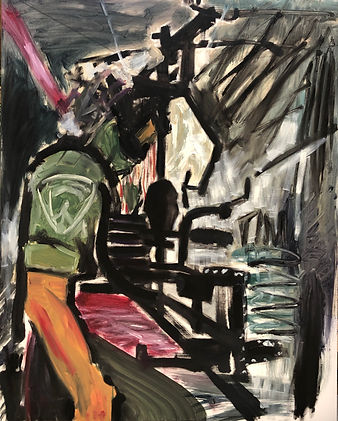
magavnik in the gym, 2019
Oil on Canvas 100x80cm
Black and blunt outlines create a fragmented and restless painting.
On his left side appears his side of a soldier in a border guard uniform, his head is covered, and he is sitting in an enclosed space that looks like a military installation or Fighting Tools.
The soldier's body appears to be dismembered into several parts: a shoulder, an arm, a fragment of a leg and a head.
The black outlines create a skeleton that extends from the center to the edges of the fabric, highlighting the parts from them The body is built, its impermanence and weakness.
The soldier is held by means of this net, without which the whole painting will collapse in on itself like a house of cards.
Picturesque gestures and brush scribbles fill the spaces that remain empty around the instruments and the figure of the soldier, masking and staining the painting with gloom.
The gym as a place of potency and masculinity looks like a deflated balloon.
"The Armor Monument", 2017 I recognize Oded.
His character looks peaceful and reconciled. He stands and urinates in a bow on a tank, smiling And a little embarrassed by the situation, maybe because he is exposed to the eyes of whoever recorded it.
This is a moment of Catharsis: The yellow liquid lubricates the caterpillars and the cold metal wheels of the tank; connection established, A bridge, between man and machine, between Oded and his past as a soldier.
Again the thought of his attempt to merge comes to mind The act of painting, the materials that make it up, with contemporary reality, with time, with the history The liquid that comes out of his body is linseed oil and turpentine. In this sense the urine that dripped on The tank is also the other fluid in the painting. It's an ironic situation: Oded seems to be urinating on his painting.
He pees on the tank. The tank is armor, steel. It is built to protect the body, to
create around it an impenetrable shell and isolate him from the hell outside. Perhaps this is also the role of the painting for Oded and for us.

Dementia Phone, 2019
Mixed Media on Canvas
150x150cm
The cartoon phone was swallowed up in its surroundings. The intense brush strokes around the device produce Compressions of movement and materiality thus lose their role as a background, as a substrate on which an instrument is placed.
A large, old-fashioned landline phone, depicted as flat and weightless.
Concrete images appear side by side, Like photos of faces of contacts that are pasted on the device or the numbers of the buttons, next to signs Paintings of fluidity, abstract shapes and energetic body movements.
They all float in the paint. Only wired The slim contours of the phone set it apart from its surroundings. It seems that the painted areas Inside it flow into the space outside it. In this painting there is a perfect connection between the tangible and the conceptual.

Qalandiya Checkpoint, 2019
Oil on Canvas,
30x40cm
A tiny painting is my point of reference for understanding the entire exhibition. His subject and choice The small format attracts special attention. The painting requires me to get closer and see its details. The little ones: rows upon rows of people closed in iron cages, flickers of color outline heads Unidentified crowd of people squeezed into a perspective triangle towards infinity. Tidings The elite can be recognized here and there in particular clothing and facial features, black hair, beards, dark eyebrows.
This painting has the smell of sweat and the materiality of iron. One character does not let go of me; She directs Looking at me -- two white holes. The canvas looks back at me and doesn't let go.
***
From the appearance of weakness, the strength in these paintings becomes clear.
Wisely and with few means Oded Ya'akov expresses the inability of the empathic person, born with over-sensitivity and wanting Morally, to resist the boring mechanisms of the corrupting power.
He describes wrongdoing by his parents and grandfather. They let him, but in the generation that created this reality, and that was supposed to face it, "there is no one with whom to speak".
They drew the line in rheumatism and insanity, there is no one to take responsibility. What stands at the center of his paintings is shame. The painting showcases his weakness, his weakness and his and our helplessness. In the dark Israeli reality, "as if he wanted to say that the shame will survive after him".